NDIS Support Coordination Is Changing — What Does This Mean for Housing?
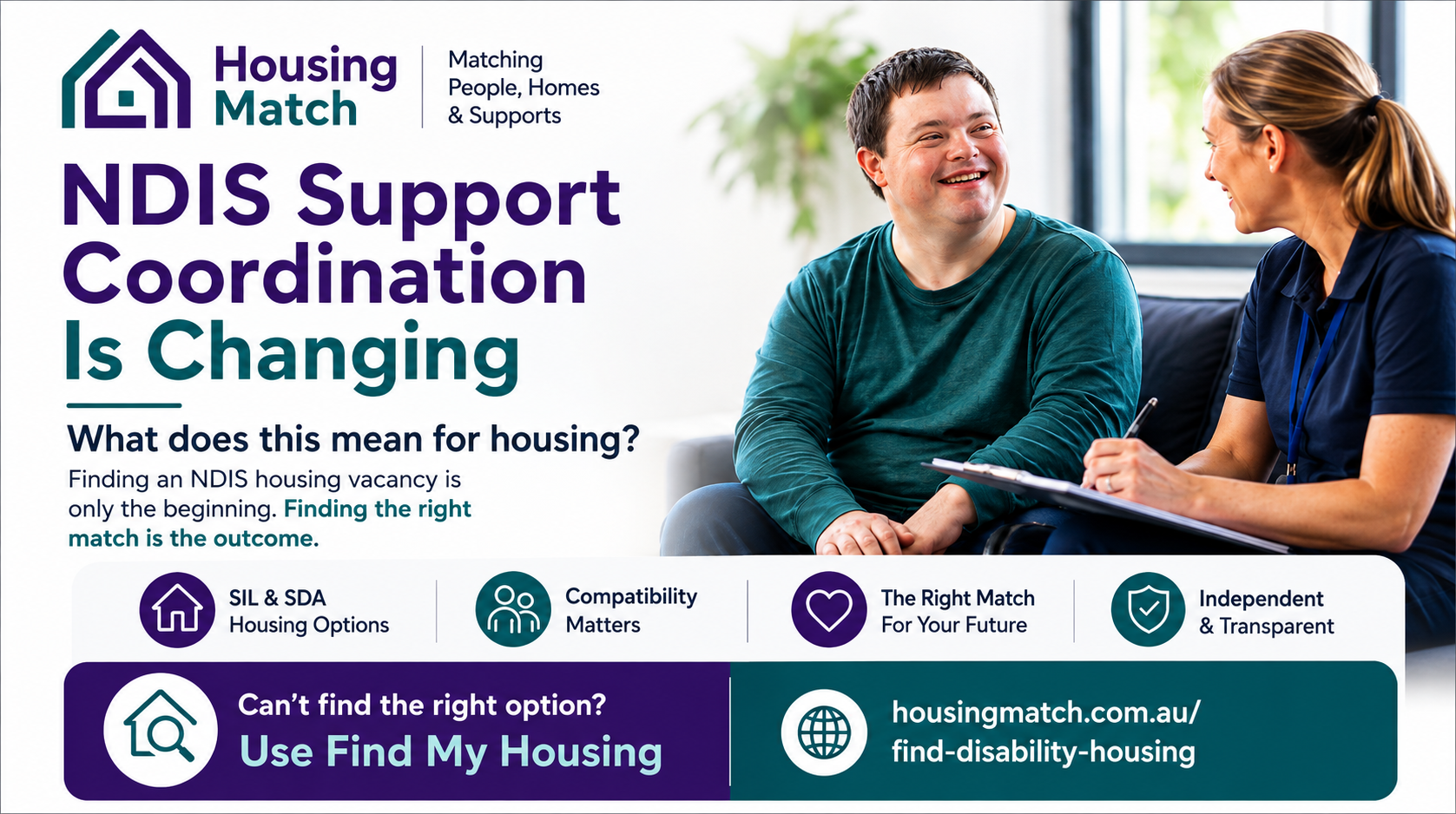
NDIS Support Coordination is changing. What could this mean for people navigating SIL, SDA and complex disability housing? Finding a vacancy is only the beginning — finding the right match matters.
In This Article
- 1. Finding an NDIS housing vacancy isn't enough
- 2. Complex NDIS housing still requires skilled navigation
- 3. Technology shouldn't replace specialist Support Coordination
- 4. Independence can also be demonstrated through the options presented
- 5. This is what we're building with Housing Match
- 6. Can't find the right housing option? Use Find My Housing
- 7. What happens between now and 2028 matters
- 8. Looking for SIL, SDA or another NDIS housing option?
The NDIS Support Coordination landscape is changing.
The Australian Government has announced plans to introduce a commissioned Support Coordination and Connection model from 1 July 2028.
There is still much we don't know about exactly what the future model will look like, how Support Coordination services will be commissioned, or what this will mean for individual Support Coordinators and organisations.
Those are important conversations.
But as the NDIS sector considers what comes next, there is another question worth asking:
What will these changes mean for NDIS participants trying to navigate complex housing decisions?
Because for people looking for Supported Independent Living (SIL), Specialist Disability Accommodation (SDA) or other disability housing options, Support Coordination can involve much more than simply connecting someone with an available service.
Finding an NDIS housing vacancy isn't enough
Finding an available SIL or SDA property is only one part of the housing journey.
A property can be accessible, located in the right area and have an available bedroom — and still not be the right home for the person.
People have individual needs and preferences about where, how and with whom they want to live.
That can include:
- location and connection to family, friends and community
- accessibility and SDA design requirements
- SIL support needs and preferred support arrangements
- daily routines and lifestyle
- social interaction and shared activities
- household environment and noise
- pets and smoking preferences
- age, interests and personality
- cultural considerations
- level of independence
- who they feel comfortable sharing their home with.
For participants considering shared SIL housing, compatibility can be just as important as the property itself.
A successful NDIS housing placement isn't simply:
Participant + Vacancy.
It's about bringing together:
Person + Preferences + Property + Support + Compatibility.
Complex NDIS housing still requires skilled navigation
For many participants, these decisions are made during incredibly complex circumstances.
A person may be transitioning from hospital, experiencing homelessness or housing instability, moving from their family home, experiencing the breakdown of an existing SIL arrangement, looking for a new SIL provider, or considering SDA for the first time.
They may need to navigate SIL, SDA, mainstream rental, community housing and other disability housing pathways, while also considering their NDIS funding, support requirements and personal circumstances.
That's much more than searching a vacancy list.
It's complex housing navigation.
And for participants with significant or complex needs, there remains an important role for experienced and specialist NDIS Support Coordination.
Technology shouldn't replace specialist Support Coordination
As the NDIS changes, technology will undoubtedly play a greater role in connecting people with services and information.
But technology shouldn't replace the professional judgement of an experienced Support Coordinator.
It should give them better information and more options to work with.
No individual Support Coordinator can reasonably know every SIL provider, SDA provider, property, vacancy, potential housemate or emerging NDIS housing opportunity.
Support Coordinators have traditionally built that knowledge through professional networks, provider relationships, vacancy emails, spreadsheets, social media groups and years of experience.
Those relationships remain incredibly valuable.
Independent platforms and services can complement them by providing another source of information and helping participants and Support Coordinators explore a broader range of possibilities.
Independence can also be demonstrated through the options presented
As Support Coordination evolves, there will understandably be increased discussion about independence, transparency and conflicts of interest.
For independent Support Coordination organisations, independence isn't only about what services an organisation does or doesn't provide.
It can also be demonstrated through how options are identified, considered and presented to participants.
Using independent systems and resources can help Support Coordinators explore SIL, SDA and other NDIS housing opportunities across different providers without being financially connected to the provider ultimately selected.
That can strengthen:
Choice. Transparency. Comparison. Compatibility. Informed decision-making.
Most importantly, it helps keep the participant's individual needs, goals and preferences at the centre of the housing decision.
This is what we're building with Housing Match
Housing Match is an independent platform being developed to help participants and the professionals supporting them navigate NDIS housing, SIL, SDA and other disability housing options differently.
We're not trying to build another vacancy board.
We're trying to help answer a much more important question:
Is this actually the right match for this person?
Housing Match allows individual housing needs and preferences to become part of the search.
The platform is designed to help participants and Support Coordinators explore potential properties and providers, communicate around housing opportunities and consider compatibility, particularly where someone may be sharing a home with other participants.
Because an available SIL bedroom doesn't necessarily mean two people should live together.
The participant's preferences, lifestyle, support needs and compatibility with the household matter.
Housing Match does not operate SIL services.
It does not own SDA properties.
And Housing Match doesn't benefit because a Support Coordinator chooses one SIL, SDA or support provider over another.
Our role is to help make NDIS housing information, options, compatibility and connections more accessible and transparent.
Can't find the right housing option? Use Find My Housing
Housing Match is still growing, and we know not every SIL vacancy, SDA property or NDIS housing option will currently be listed.
That's why searching existing properties is only one part of Housing Match.
If you can't find an option that meets the participant's needs, use Find My Housing to tell us what you're looking for.
Support Coordinators and participants can provide information about their:
- preferred location
- SIL, SDA or other housing requirements
- accessibility needs
- support requirements
- individual preferences
- lifestyle and compatibility considerations
- other factors important to finding the right home.
Housing Match can then use this information to help identify and connect them with other SIL, SDA and disability housing options — including providers and properties that may not yet be listed on Housing Match.
It means the housing search doesn't have to stop because the right vacancy isn't currently visible.
Instead of trying to fit a participant into what's available, Find My Housing starts with the person and what they're actually looking for.
For NDIS Support Coordinators, access to Housing Match is free.
Search what's available. Consider the match. And if it's not there, tell us what you're looking for so we can help find other options.
What happens between now and 2028 matters
There will be considerable discussion about the future of NDIS Support Coordination as the sector moves toward a commissioned model.
There are still important details to come, and we shouldn't assume what the final model will look like before those details are released.
But regardless of the eventual commissioning arrangements, people with complex housing needs will still need help navigating significant decisions involving SIL, SDA, NDIS housing, support providers and potential living arrangements.
They need skilled people supporting those decisions.
And those professionals need access to independent information, systems and resources that help them identify genuine alternatives based on the participant's individual needs and preferences.
Because a successful NDIS housing outcome isn't simply about finding somewhere with an available room.
It's about finding a home that works for the person — their needs, their preferences, their supports and, where they share their home with others, the right compatibility.
Finding an NDIS housing vacancy is the beginning. Finding the right match is the outcome.
Looking for SIL, SDA or another NDIS housing option?
Search what's available — or tell us what you're looking for through Find My Housing and we'll help explore other options.
Originally published by Housing Match on LinkedIn, 20 August 2026. View the original article on LinkedIn.
Explore More
Search NDIS Housing
Find available SIL vacancies and SDA properties across Australia.
Search Properties