Support Coordinator's Guide to Finding NDIS Housing for Your Clients
A practical guide for Support Coordinators on how to search SIL and SDA vacancies, create referral packs, and navigate the NDIS housing system more efficiently for the people you support.
In This Article
- 1. The Support Coordinator's Role in Housing
- 2. Step 1: Build a Complete Participant Profile
- 3. Step 2: Gather Supporting Documents
- 4. Step 3: Search for Compatible Properties
- 5. Step 4: Create and Submit Referral Packs
- 6. Step 5: Track and Follow Up
- 7. Common Challenges and How to Address Them
- 8. Conclusion
The Support Coordinator's Role in Housing
For many NDIS participants, the support coordinator is the most important person in their housing journey. You're the one who understands their needs, knows the system, and has the relationships to make things happen. But the NDIS housing system is fragmented, slow and often opaque — making your job harder than it needs to be.
This guide covers the key steps, tools and strategies that can make your housing search and referral practice more effective.
Step 1: Build a Complete Participant Profile
The quality of a housing referral depends almost entirely on the quality of the information you provide. Before searching for properties, build a thorough participant profile that includes:
- Support needs: daily living, personal care, overnight support requirements
- NDIS funding: SIL allocation, SDA approval (if applicable), core supports, plan type
- Functional capacity: what the participant can and cannot do independently
- Behaviour support: any BSP requirements or known risks
- Lifestyle preferences: interests, daily routine, social preferences, community goals
- Location requirements: proximity to family, services, work or day programs
- Housemate preferences: gender, age range, household size, quiet vs social environment
- Accessibility requirements: physical, sensory or communication-related needs
Step 2: Gather Supporting Documents
A strong referral pack should include:
- Occupational Therapist functional assessment
- Behaviour Support Plan (if applicable)
- NDIS plan summary or relevant plan sections
- Health and medication summary (with participant consent)
- Previous support coordinator reports
Housing Match allows you to upload these documents directly to the participant's profile. The AI document extraction feature can automatically pull relevant information from OT reports and functional assessments to pre-populate profile fields.
Step 3: Search for Compatible Properties
With a complete profile, you can search Housing Match for SIL vacancies and SDA properties that match your participant's needs. Use filters for:
- State and region
- Support ratio (1:1, 1:2, 1:3)
- Disability type and expertise
- Accessibility features
- Funding type accepted
For each shortlisted property, Housing Match generates an AI compatibility assessment showing how well the participant matches the property across all key domains.
Step 4: Create and Submit Referral Packs
Rather than emailing documents back and forth, Housing Match allows you to create a structured digital referral pack for each application. The referral pack is sent directly to the provider's dashboard, where they can review, respond and update the application status.
Step 5: Track and Follow Up
From your support coordinator dashboard, you can monitor the status of all housing applications across your caseload — from submitted through to shortlisted, inspection scheduled and confirmed placement.
Set reminders to follow up with providers who haven't responded within 5 business days. Persistent, polite follow-up is often the difference between an application that progresses and one that stalls.
Common Challenges and How to Address Them
Challenge: Providers reject referrals without clear feedback. Solution: Ask for specific feedback on why the participant wasn't a good fit. This helps you refine future applications.
Challenge: Participant profile is incomplete. Solution: Prioritise OT assessment and functional evaluation before starting the housing search.
Challenge: No suitable vacancies in the participant's preferred location. Solution: Expand the search radius, consider adjacent regions, and register the participant's profile so providers can proactively reach out when vacancies arise.
Conclusion
Effective housing coordination requires preparation, persistence and the right tools. Housing Match is designed to make your job easier — from building profiles and searching properties to submitting referrals and tracking outcomes.
Register free as a Support Coordinator or explore our Support Coordinator resources.
You May Also Be Interested In
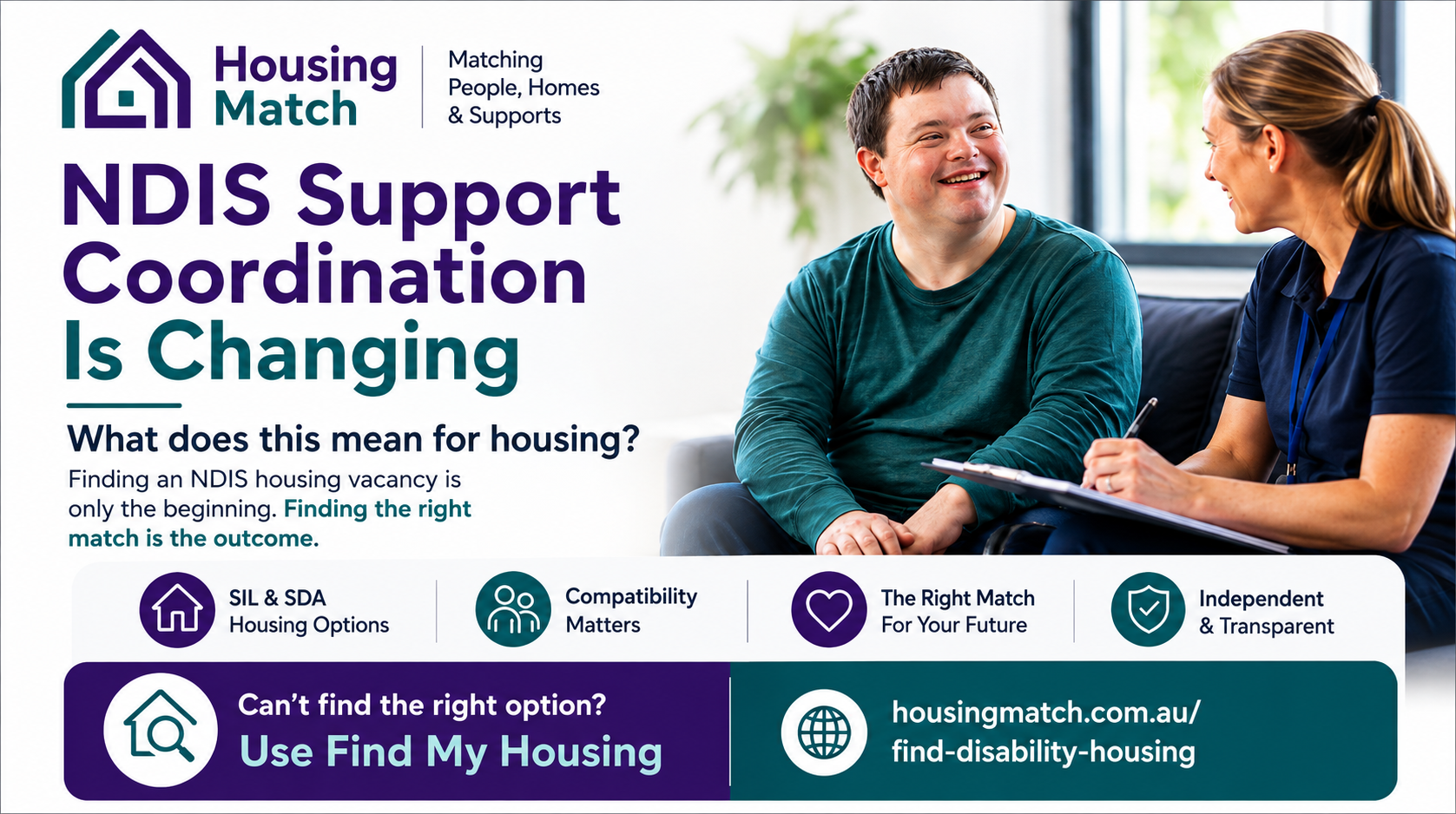
NDIS Support Coordination Is Changing — What Does This Mean for Housing?
NDIS Support Coordination is changing. What could this mean for people navigating SIL, SDA and complex disability housing? Finding a vacancy is only the beginning — finding the right match matters.

Improving Hospital Discharge Outcomes for NDIS Patients: A Guide for Social Workers
Delayed hospital discharge due to inadequate disability housing is a growing challenge across Australia. Here's how hospital social workers and discharge planners can use Housing Match to find appropriate NDIS accommodation faster.
Explore More
Search NDIS Housing
Find available SIL vacancies and SDA properties across Australia.
Search Properties